
The year end close checklist is the difference between a calm January and a scramble. When your financial year ends, the books must be reconciled, adjusted, and locked — and every number on your tax return starts with what you finish in these weeks.
Most small businesses do not fail at year end because the work is hard. They fail because the work is scattered: a bill found in a drawer, a deposit that never matched, a contractor who never sent a form. A checklist fixes that.
Year End Close Checklist
A year end close checklist is a list of every task you finish before locking the books for the year: reconciliations, adjustments, payroll and tax prep, then financial statements. Run it in four phases, twenty checks, and you close clean — records ready for taxes, audits, and next year’s opening balances.
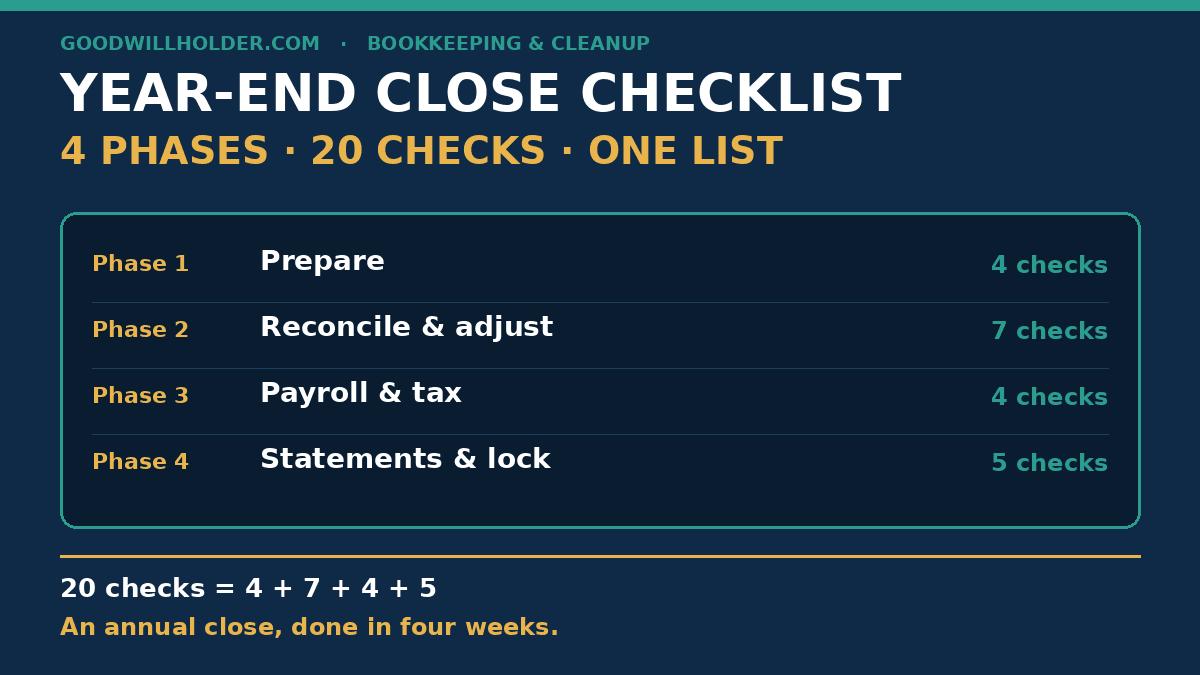
The 20 checks, phase by phase
Here is the full year end close checklist, phase by phase. Work top to bottom; the order matters more than the speed.
Phase 1: Prepare — 4 checks (4–6 weeks before year end)
- Build the timeline. Set deadlines, assign owners, and decide who signs off on the close.
- Gather the records. Bank statements, credit card statements, loan agreements, and prior tax returns — all in one place.
- Send the cut-off memo. Tell your team the last date for expense reports, bills, and supplier invoices.
- Open one year end folder. Every file you touch during the close should land in it.
Phase 2: Reconcile and adjust — 7 checks
- Reconcile every bank and credit card account to its statement — cash first; nothing else is trustworthy until cash matches (see: how to reconcile a bank account, or run it in Google Sheets).
- Review accounts receivable. Chase overdue balances, apply unapplied payments, and write off bad debt.
- Review accounts payable. Unpaid bills, vendor statements, and the aging report should tie to the ledger.
- Count inventory physically and value it. Adjust for shrinkage, damage, and obsolete stock.
- Update the fixed asset register. Purchases, disposals, and a full year of depreciation.
- Post accruals and deferrals. Accrued expenses, prepaid amortization, and deferred revenue.
- Reclassify debt. Split what is payable within twelve months from what is not.
Phase 3: Payroll and tax prep — 4 checks
- Audit payroll. Gross wages, bonuses, commissions, and benefits must tie to the ledger.
- Draft contractor forms. 1099-NEC in the US — confirm addresses now, not in January.
- Prepare annual payroll reports. W-2s for US teams, the equivalent statutory reports elsewhere.
- Check indirect tax filings (sales tax, VAT, GST) and draft the income tax provision with your accountant. The IRS small business pages list the US deadlines.
Phase 4: Statements and lock — 5 checks
- Run the trial balance. Debits must equal credits before anything else moves.
- Generate the statements: profit and loss, balance sheet, and cash flow.
- Variance check. Actual vs budget vs last year — investigate every surprise.
- Set opening balances for the new year and roll the budget forward.
- Back up and lock the period in your accounting software (see QuickBooks or Xero close and lock tools).
A worked example: Lakeview Bakery closes the year
Here is how the year end close checklist runs at Lakeview Bakery, a small bakery with one part-time bookkeeper.
- Insurance. A $1,200 policy was bought on July 1 for twelve months. At December 31, six months are used: $1,200 = $600 expense + $600 prepaid.
- Inventory. The shelf count is 128 units, the books say 132. The write-off is 4 units of shrinkage (132 − 128 = 4).
- Bad debt. One $410 invoice belongs to a customer who closed down — write it off, and receivables drop by $410.
- Trial balance. Total debits $42,680 and total credits $42,680 — equal, so the statements go out and the year gets locked.
Total workload: twenty checks over four weeks, a few hours at a time.
How long the year end close takes
With clean monthly books, a year end close checklist takes a small business roughly 10–15 hours of focused work, spread over two to four weeks. If months are still unreconciled, close those first — the month end close checklist and a proper bookkeeping cleanup will save your January.
Common questions
What are the steps involved in a year end close checklist?
Four phases and twenty checks: prepare the timeline and records, reconcile and adjust (cash, receivables, payables, inventory, fixed assets, accruals), finish payroll and tax prep, then produce the statements and lock the period. The full list is above — work top to bottom and tick each check as you finish it.
How do you make a closing checklist?
Start from your own books, not a generic template. List every account you hold, every report you file, and every deadline your state or software imposes. Group them into the four phases, give each task an owner and a date, and refine the master copy after every close.
What are the three golden rules of accounting?
Debit the receiver and credit the giver; debit what comes in and credit what goes out; debit expenses and losses and credit incomes and gains. They are the bookkeeping rules behind the trial balance — if debits equal credits at year end, the rules held all year.
What are year end activities?
Year end activities are the tasks a business completes before closing its annual books: reconciliations, inventory counts, depreciation, bad debt write-offs, payroll audits, tax form drafts, financial statements, and locking the period. The checklist above turns them into one sequence you can finish before filing season.
If you would rather not do it
You do not have to run this yourself. I build money-tracking spreadsheet systems and take on year end cleanup for small service businesses in the US and UK — clean books, a locked period, and a checklist your team can reuse next year. Write through the contact page on this site.
Key takeaways
- A year end close checklist runs in four phases and twenty checks: prepare, reconcile and adjust, payroll and tax, statements and lock.
- Cash first — bank and card reconciliations must be done before anything else is believable.
- The small adjustments carry the year: prepaids, accruals, depreciation, and bad debt decide whether the reported profit is real.
- The trial balance must balance before the statements leave the building.
- Back up and lock the period the day you finish. That is what turns a tidy pile of work into a close.