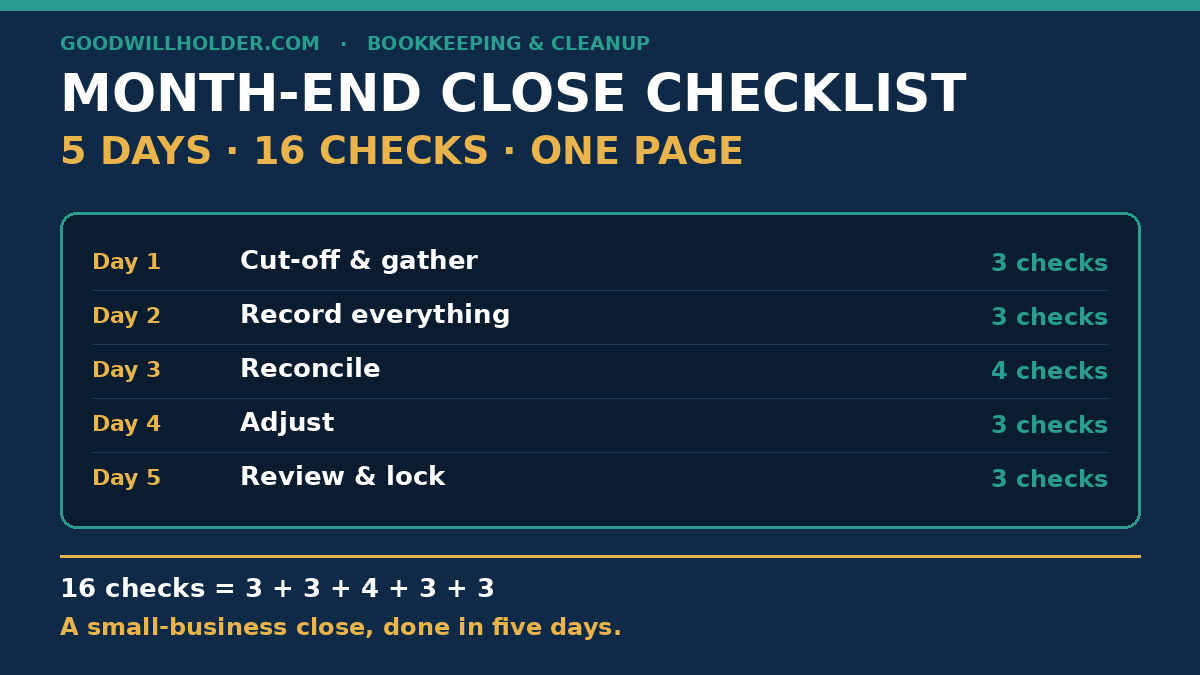
Five days, sixteen checks, one page — the small-business close.
A month end close checklist is the cure for the dread of month end. The receipts pile up, the bank number doesn’t match, and the profit and loss stays unopened — not because closing is hard, but because without a list, every month is invented from scratch.This is that list: five phases, sixteen checks, five days — built for a small business, not a finance department. Print it, paste it in your workbook, and next month closing becomes a routine instead of an emergency.Key takeaways
A month end close checklist is the fixed list that turns a month of raw transactions into reports you can trust.
The order never changes: cut off, record, reconcile, adjust, review and lock.
Sixteen checks total — 3 + 3 + 4 + 3 + 3 — spread across five days.
Day 3 (reconcile) is the day that protects everything else. Never skip it.
Build your own version by walking your P&L and balance sheet backwards from each line item.
A month end close checklist is the fixed list of checks that turns a month of raw transactions into reports you can trust — record everything, reconcile the accounts, post the adjustments, review, and lock. Same order every month, so closing becomes a routine instead of an emergency.
The Small-Business Close: 5 Days, 16 Checks
Below is the whole month end close checklist — free to copy. Each phase gets one day, but a light month can collapse into two or three. The counts matter more than the calendar: 3 + 3 + 4 + 3 + 3 = 16 checks, and all sixteen need a tick before the month is closed.
Day 1 — Cut-off and gather (3 checks)
☐ Set the cut-off. Every invoice, receipt, and expense for the month is in by the end of Day 1. In a solo business, the reminder goes to yourself.
☐ Confirm the feeds. Bank, card, and payroll accounts have all imported through month end. A feed that stopped on the 27th will lie to you all month.
☐ Pull the baseline. Last month’s P&L and balance sheet open in a tab — they are the comparison for Day 5.
Day 2 — Record everything (3 checks)
☐ Income side: all sales logged, all customer payments applied to the right invoices. If invoices are still open after being paid, the pending payments tracker will tell you which ones.
☐ Spending side: every vendor bill and expense entered in your accounting system — whether that’s QuickBooks Online, Xero, or a spreadsheet — including the card receipts living in your email. Petty cash counted if you keep any.
☐ Payroll posted: wages, withholdings, and any owner draws recorded to their proper accounts.
Day 3 — Reconcile (4 checks)
☐ Bank account tied to the statement — variance zero. The manual method is in our bank reconciliation guide.
☐ Credit cards tied to their statements. Personal spending on the business card gets split out to Owner’s Draw here.
☐ Sub-ledgers agree: the A/R aging equals what customers actually owe; the A/P aging equals what you actually owe.
☐ Clearing accounts cleared: undeposited funds, suspense, and petty cash float all sit at zero or at an explainable number.
Day 4 — Adjust (3 checks)
☐ Accrue the unbilled: utilities, interest, and subscriptions used this month but not yet invoiced to you.
☐ Spread the prepaid: insurance or annual fees paid in advance move to the right month, one slice at a time.
☐ Depreciation and bad debt: post depreciation if you own equipment; review the oldest receivables and write off what will never come in.
Day 5 — Review and lock (3 checks)
☐ Read the P&L against last month — and explain every jump before it explains you. The monthly P&L sheet is built for exactly this glance.
☐ Check the balance sheet ties: cash matches the reconciliations, loans match the lender’s letters, A/R and A/P match the agings.
☐ Sign off and lock. Protect the period, file the statements and notes where future-you will find them. The month is closed.
Example: Lakeview Bakery’s Five-Day Close
Lakeview Bakery — a composite of real small-business closes — used to “close” by opening the accounting app whenever the owner panicked, which averaged out to never. The first month on this month end close checklist ran like this:Day 1 (about 30 minutes): the cut-off note went out, the card feed turned out to have stopped on the 27th and got re-imported, and August’s reports came out of the drawer. Day 2 (an hour): three customer invoices, eleven vendor bills, and the owner’s draws went in. Day 3 (an hour): the bank tied at zero after one duplicate charge surfaced — the same $240 fuel payment entered twice. Day 4 (45 minutes): the prepaid insurance got its monthly slice. Day 5 (45 minutes): the P&L told a story she actually believed, and the month locked.The arithmetic of the job: 3 + 3 + 4 + 3 + 3 = 16 checks, and at roughly 45 minutes a day across 5 days, the whole close was under four hours of real work. The catch — the one everyone learns — is that this only works if every month gets the same sixteen ticks.
How to Make Your Own Closing Checklist
Steal the controller’s trick: start from the financial statements and walk backwards. Take each line of your P&L and balance sheet and ask, “What must be true this month for this number to be right?”Cash must match the bank — that’s a reconciliation. A/R must match the unpaid invoices — that’s a sub-ledger tie. Depreciation must be posted for the equipment line to mean anything. Write each answer as a tickable check, keep the ones that apply to your business, drop the ones that don’t, and you have a month end close checklist that fits your books instead of an enterprise’s. Sixteen checks is a starting point; twelve is fine if that’s your reality — as long as the same twelve happen every month.
Frequently Asked Questions
What is a month end close checklist?
A month end close checklist is the fixed list of steps that closes one accounting month: record every transaction, reconcile the accounts, post the adjustments, review the reports, and lock the period. Same list every month — that repetition is the entire point, because it turns closing from a project into a habit.
How do you perform month-end closing?
Work the five phases in order: cut off and gather (Day 1), record everything left over (Day 2), reconcile cash and cards and sub-ledgers (Day 3), post accruals, prepaids, and depreciation (Day 4), then review the P&L and balance sheet and lock (Day 5). Order is what makes it work.
What is month-end close in R2R?
“Record to report” is the enterprise name for the same journey — the month end close checklist under a bigger name. Large companies split it across departments; a small business walks the whole road alone: record, reconcile, adjust, report, close. The distance is shorter than the jargon suggests.
How long should the month-end close take?
For a small service business, one to five days depending on transaction volume — a few hours of real work spread across the week. Don’t chase speed in month one. Chase the same order every month; speed arrives on its own by month three.
If Closing Day Is the Worst Day of the Month
It doesn’t have to stay that way. I build money-tracking spreadsheet systems for small service businesses in the US and UK — and I clean up the files that have gone months without a close. One system, fixed scope, fixed price. If that would help, get in touch.