
A bookkeeping cleanup starts the same way almost every time. A lender asks for financials and you hesitate before pressing send. Or you open the profit and loss, see a number that does not match your gut feel for the business, and close the tab again. The money is not missing. The records are simply wrong — and wrong records are worse than no records, because you believe them.
This guide walks through what a bookkeeping cleanup actually involves, the order the work must follow, a checklist you can run yourself, what it costs in 2026, and the honest line between doing it yourself and handing it off.
Key takeaways
- Bookkeeping cleanup repairs records that already exist but don’t tie out — it is not catch-up entry and not tax filing.
- Order matters: scope first, then reconcile cash oldest-month-first, then categorize, then A/R, A/P and payroll, then review and lock.
- Never force a reconciliation to balance. A plug hides the real error one layer deeper.
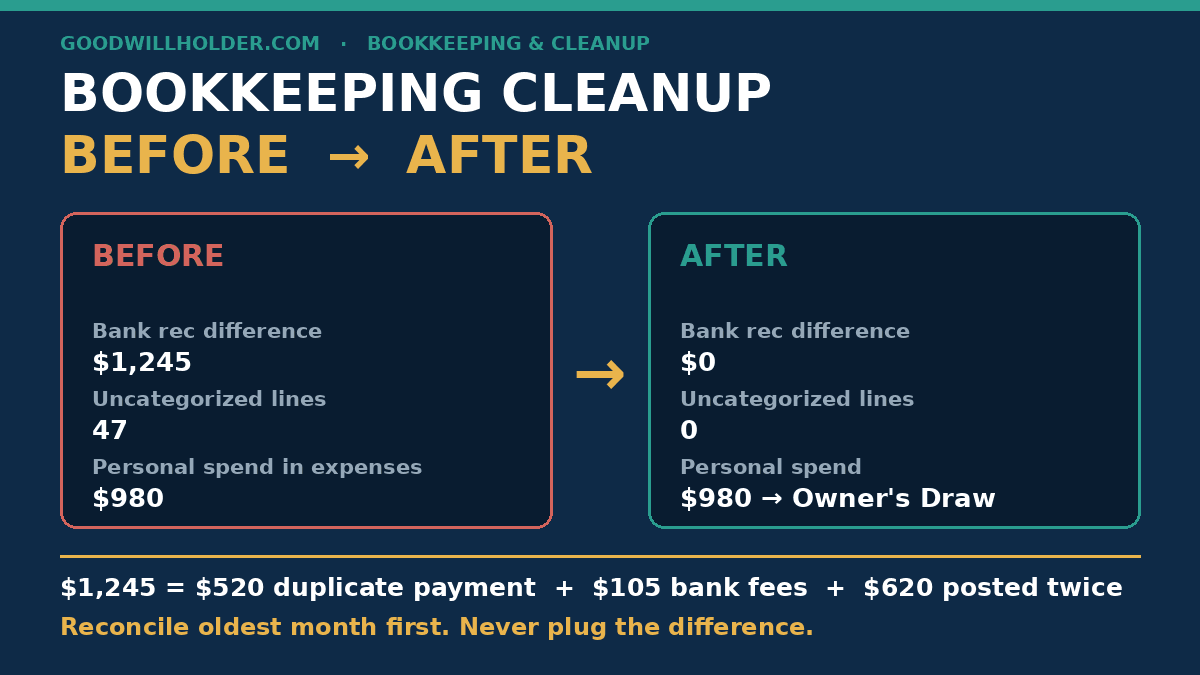
- A worked example: a $1,245 bank difference that was really a duplicate payment, unpaid bank fees, and a double-posted customer payment.
- 2026 market ranges run about $300 for a short cleanup to $10,000+ for multi-year messes — scope is the real price driver.
- A cleanup with no monthly close behind it becomes next year’s cleanup project.
What Is Bookkeeping Cleanup?
Bookkeeping cleanup is a one-time repair of records that already exist but don’t match reality: unreconciled accounts, miscoded transactions, duplicates, and personal spending mixed into business costs. It is not catch-up entry and not tax filing. The work ends when every account ties to its statement and the reports can be trusted again.
Bookkeeping Cleanup vs Catch-Up Bookkeeping
People use the two terms interchangeably, and that confusion costs them money when they hire help. Catch-up bookkeeping means the books are behind but not broken: months of transactions were simply never entered. The work is typing and reconciling forward until the file is current.
Bookkeeping cleanup means what is recorded is wrong: miscoded transactions, broken reconciliations, commingled cards, duplicated entries, band-aid journal entries from a previous bookkeeper. The work is diagnosis and correction. Many neglected files need both — missing months entered and recorded months fixed — and telling a professional which situation you are in speeds up the quote enormously.
Signs Your Books Need a Cleanup
Messy books have symptoms. Watch for these:
- The bank balance in QuickBooks or Xero doesn’t match your statement, even after you hit “reconcile”.
- The same expense shows up twice — once from the bank feed, once from a manual entry.
- There is a pile of uncategorized transactions, or an “Ask My Accountant” list nobody touches.
- Paid invoices are still sitting in accounts receivable.
- Your profit and loss contradicts your sense of how the business is actually doing.
- Personal spending runs through the business card, or one account handles everything.
- A lender, investor, or buyer just asked for financials — and you hesitated.
Two of these at once is a project to scope properly, not a weekend job.
The Bookkeeping Cleanup Process: 5 Phases
Order is the whole game. Start with the profit and loss before the balance sheet is reconciled and you will redo the work. This is the sequence that holds up in real files.
Phase 1: Set the scope and gather the evidence
Pick the exact period — last quarter, the full prior year, since inception — and write it down. Open-ended cleanups sprawl. Collect bank and credit card statements, loan statements, payroll reports, and processor payout reports if you take Stripe or Square. Then export baseline reports — profit and loss, balance sheet, trial balance — before you change anything. If the period touches a filed tax return, treat it as a hard boundary: flag what looks wrong instead of editing freely.
Phase 2: Reconcile cash and cards, oldest month first
Start with the oldest unreconciled month and move forward. Never skip around. Match every transaction against the actual statement in QuickBooks Online or Xero, and watch for the three usual suspects: transfers miscoded as income or expense, duplicates from a bank feed plus a manual entry, and payments posted to the wrong month. If a reconciliation “balances” only because someone entered a mystery adjustment, it is not done — it is deferred.
Phase 3: Clear the pile and recode transactions
Open the uncategorized list, sort biggest first, and match each line to its receipt, bank line, or email confirmation. Recode it to the real category. Fix the bank rule that caused the mess instead of correcting the same line every month. Split mixed transactions — business part to an expense account, personal part to owner’s draw. This phase eats the most time; our uncategorized expense guide covers the recoding screens transaction by transaction.
Phase 4: Fix A/R, A/P, payroll, and owner activity
Pull the A/R aging report and match it to what customers actually owe: close invoices marked open that were really paid, apply payments sitting in holding, and write off balances that will never be collected. If deposits are tangled up, our undeposited funds cleanup is the other half of that picture. Then flip direction for A/P: bills marked open that were paid, vendor credits never applied, duplicate bill entries. Tie payroll expense and liabilities to your provider’s reports — never estimate those. Finally, owner money: draws and contributions belong in equity, not in expenses (see opening balance equity if the owner ever funded the business), and loan balances must agree with lender statements, with principal split from interest.
Phase 5: Review, document, and lock
With the balance sheet tied out, read the profit and loss month over month. A category that spikes for no reason or a margin swing that makes no sense gets investigated before anyone calls this done — this catches what reconciliation alone misses. Save every reconciliation report and a short written note for each adjustment and why you made it. Then lock the period so past transactions cannot be edited by accident. The last step is a monthly routine, because a cleanup with no close process behind it unravels faster than people expect.
The Bookkeeping Cleanup Checklist
Run this in order. It is the same skeleton the five phases describe, in tickable form.
Scope & setup
- ☐ Cleanup period defined and written down
- ☐ Bank, card, loan, and payroll statements collected for that period
- ☐ Baseline P&L, balance sheet, and trial balance exported before any change
Bank & credit cards
- ☐ Every account reconciled to its statement, oldest month first
- ☐ No duplicates between bank feeds and manual entries
- ☐ Transfers coded as transfers — not income, not expense
- ☐ No plug entries forcing a reconciliation to balance
Transactions
- ☐ Uncategorized pile cleared, biggest items first
- ☐ Bank rules reviewed so the same error doesn’t return
- ☐ Personal spending split out to owner’s draw
- ☐ Duplicate accounts merged in the chart of accounts
A/R and A/P
- ☐ A/R aging matches the invoices customers actually owe
- ☐ Payments applied to the correct invoices
- ☐ A/P aging matches what the business actually owes
- ☐ Vendor credits applied; duplicate bills removed
Payroll, loans, and owner activity
- ☐ Payroll expense and liabilities tie to provider reports
- ☐ Loan balances match lender statements; principal and interest split
- ☐ Owner draws and contributions sitting in equity, not expense
Final review
- ☐ P&L checked for unexplained month-to-month swings
- ☐ Reconciliation reports and adjustment notes saved
- ☐ Period locked
Example: How a $1,245 Bank Difference Vanished
Lakeview Bakery — a composite of real cleanup files — came into a cleanup with three symptoms at once: a bank reconciliation that refused to tie by $1,245, 47 lines sitting in uncategorized, and $980 of personal spending sitting inside business expenses.
The $1,245 was not one mystery. It was three:
- $520 — a duplicate vendor payment. The March insurance bill was entered by hand and then matched again from the bank feed. Twice paid, once owed.
- $105 — unrecorded bank fees. Twelve small monthly charges nobody had entered.
- $620 — a customer payment posted twice. The deposit hit the books from the feed and from a manual entry.
The math: $520 + $105 + $620 = $1,245. Every dollar traced back to a real event, which is why plugging the difference would have been so expensive — it would have buried all three errors inside one “miscellaneous” line. The $980 moved to Owner’s Draw, where it belonged: it was never a business expense. After the split, the reconciliation tied to zero, the uncategorized list was empty, and the profit and loss finally matched the owner’s read on the business.
What Does Bookkeeping Cleanup Cost in 2026?
Cleanup is usually priced as a project, and the scope — not the hourly rate — decides the number. Firms publishing 2026 rates band projects roughly like this:
- A few months behind, simple books: about $300–$800
- A half-year of mess, several accounts: about $800–$2,500
- Six to twelve months, payroll or processors involved: about $1,500–$5,000+
- Multi-year or commingled books: $3,500–$10,000+
These are market reference ranges, not fixed rates. The price drivers are the same everywhere: how many months are involved, transaction volume, how many bank, card, loan, and processor accounts exist, how many records are missing, and whether personal and business spending are mixed. Time follows the same logic — a short cleanup can take a few focused days, while a multi-year rebuild commonly runs two to six weeks. Whatever a provider charges, the standard to insist on is simple: scope agreed before work starts, and no surprise invoice at the end.
Should You DIY or Hire It Out?
Do it yourself when all of these are true: you are under about three months behind, you have one or two bank accounts and a card, transaction volume is under roughly fifty a month, personal and business spending are already separate, and you are comfortable in QuickBooks or Xero with the hours to spare. Work the five phases in order and the checklist will get you home.
Hand it off when you are six months behind or more, payroll or a payment processor is involved, personal and business money are mixed, someone is waiting on your financials — a lender, an investor, a tax deadline — or you have already tried and the numbers still don’t tie. The real comparison is opportunity cost: weekends spent untangling bank statements are weekends not spent running the business.
Frequently Asked Questions
What is the difference between bookkeeping cleanup and catch-up bookkeeping?
Catch-up bookkeeping records months and transactions that were never entered. Bookkeeping cleanup corrects data that already exists but is wrong, duplicated, or unreconciled. Behind-but-fine books need catch-up; recorded-but-untrustworthy books need cleanup. Many neglected files need both, in that order.
How long does a bookkeeping cleanup take?
A short cleanup with a few months of mess and simple accounts can take a few focused days. A multi-year file with payroll, processors, and commingled accounts commonly runs two to six weeks. The honest answer comes from looking at your actual file, not from a calendar estimate.
How much does a bookkeeping cleanup cost in 2026?
Market ranges run about $300–$800 for a simple, short cleanup, $800–$2,500 for a half-year of mess, $1,500–$5,000+ when six to twelve months or payroll are involved, and $3,500–$10,000+ for multi-year or commingled books. Scope drives price — get it defined in writing before anyone starts.
Do bookkeepers handle taxes during a cleanup?
No. A cleanup makes your records accurate; filing a return is a separate, licensed function that belongs to a CPA or tax preparer. If a cleanup uncovers something that could affect a filed return, the right move is to flag it for your CPA, not to quietly edit history.
If You Would Rather Hand It Off
A cleanup like the one above — three symptoms, one month of statements, every error traced to its source — is a day of focused work when you have done it a hundred times. I clean messy money files for small service businesses in the US and UK: exported files, fixed scope, fixed price. You get back reconciled accounts, every line in a real category, and a simple monthly habit so it doesn’t happen again. If that sounds useful, get in touch.