
What Is Catch Up Bookkeeping?
Catch up bookkeeping is the process of reconstructing, categorizing, and reconciling financial records that were missed for weeks, months, or years. It gathers old statements, enters missing income and expenses, reconciles every account against the bank, and produces current reports. A three-to-six month backlog usually clears in two to four weeks of focused work.
It is not a restart. Nothing gets erased or invented — the past simply gets recorded properly, so tax filings, loan applications, and owner decisions can finally rest on real numbers.
Why Books Fall Behind
No one plans to fall behind. It happens when the owner is the bookkeeper and the business gets busy: a growth spike, an illness, a software switch that lost history, or a shoebox of receipts “for later.” At Lakeview Bakery, Maya’s books froze in March when her second oven arrived — four months later the statements were piled up and the P&L was a guess.
What the Work Includes
A complete catch up bookkeeping project has four parts:
- Data collection. Bank and credit card statements, payment processor logs (Stripe, PayPal), receipts, invoices and loan documents — everything, in one workspace.
- Retroactive entry. Every missing income and expense item entered with proper double-entry, month by month.
- Reconciliation. Each account matched against actual statements until the books and the bank agree.
- Reports. A current balance sheet, profit and loss, and cash flow — the three documents every lender and tax preparer asks for.
7 Steps to Catch Up Your Books
These seven steps make catch up bookkeeping painless, whether you do it yourself or hand it over:
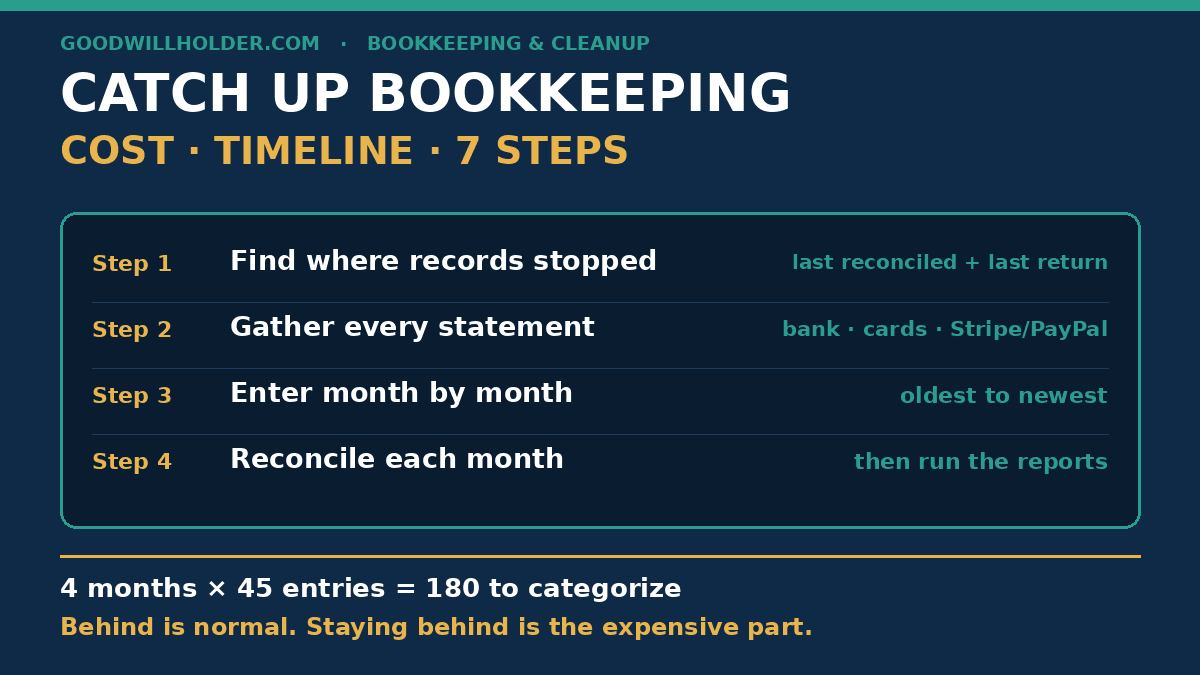
- Find where records stopped. Your last reconciled bank statement and your last filed tax return mark the line between clean and missing. Everything after that line is the project.
- Centralize every document. Paper into one folder, PDFs into one cloud folder. Typing numbers before the papers are gathered is how gaps survive.
- Connect the software. Link bank and sales feeds once — bulk imports save hours. (One connection only; reconnecting feeds creates categorized duplicates later.)
- Enter month by month, oldest first. Maya’s backlog was 4 months × 45 entries = 180 transactions. Working chronologically keeps each month testable.
- Reconcile each month before moving on. If month two does not tie to the statement, month five will not either. Our bank reconciliation guide shows the matching method.
- Fix the ugly items as they surface. Uncleared checks, missing deposits, duplicate entries, negative vendor balances — clean them while the month is open, not later. A monthly rhythm like our month-end close checklist keeps the fix permanent.
- Run the reports and read them. Balance sheet, P&L, cash flow. If Maya had read hers in March, the oven purchase would not have vanished into four months of silence.
How Long It Takes
How long catch up bookkeeping takes depends on three things: how many months are missing, how many transactions per month, and how organized the source documents are. Typical ranges:
- 1–3 months behind: a few focused days to two weeks.
- 3–6 months behind: two to four weeks.
- A year or more: four to eight weeks, longer if records are scattered.
The multiplier is mess, not months. Six tidy months with full statements can beat two months of missing receipts. Lakeview’s four months showed $58,400 of real bank outflow, but the books had recorded only $41,900 — $16,500 of missing entries waiting to be found. The rebuild also caught 40 duplicate lines among 320 imported bank rows, leaving 280 clean transactions to categorize. That is the shape of a normal project: worse than the owner feared, smaller than the pile on the desk.
What It Costs
What catch up bookkeeping costs comes down to volume and condition. Project pricing in the market runs roughly $200 to $3,000+, set by transaction count, number of accounts, and how much digging the documents need. A clean four-month backlog might run $900 — think of it as $225 × 4 months of work bought in one project. A year of chaos with two payment processors and a credit card mess sits at the top of the range.
Be careful with two extremes: a quote far below the range usually means the scope is fake (you will pay twice), and “unlimited cleanup” for a flat fee usually means corners. Honest pricing is scoped — how many months, how many accounts, what deliverables. (Doing it yourself is not free either: 180 entries is a weekend of evenings, and errors cost more than the fee you saved.)
DIY or Hire?
DIY catch up bookkeeping works when the backlog is small, the documents are complete, and you are comfortable in the software. Hire it out when months are missing, tax deadlines are close, or your time on the business earns more than the project fee. Many owners do exactly that: a professional rebuilds the past once, then a monthly routine keeps it from happening again. If you do go solo, block the hours like real appointments — the project dies in the gaps between “later tonight.”
Quick Checklist
- Mark the cutoff: last reconciled statement + last filed return.
- Gather statements, processor logs, receipts, invoices in one place.
- Enter oldest month first; reconcile before advancing.
- Fix duplicates, missing deposits, and negative balances as you go.
- Run balance sheet, P&L, and cash flow at the end.
- Install a monthly close so the backlog never returns.
Catch up bookkeeping is how owners stop paying for silence. The months you skip do not disappear — they wait, with interest, at tax time and at every loan application. Rebuild the record once, install the monthly habit, and let your numbers work for you again. When the pile looks too big to face, our bookkeeping cleanup service does exactly this work.
Need a reference standard? See this complete guide to rebuilding your books and the IRS recordkeeping guidance that a proper rebuild supports.