
The right expense categories for small business books decide whether your profit and loss report is a tool or a guessing game. When every bill lands in a named bucket, budgets hold, tax season becomes a read-across, and profit by service line is finally visible.
Most owners do not need a thirty-six-category master list. They need fourteen categories, three groups, and five sorting rules. Here is the whole system, with a month of real numbers at the end.
Expense Categories for Small Business
Expense categories for small business are the fixed buckets your books use to sort every cost — direct costs, operating costs, and admin or growth spending. Fourteen categories cover almost any small firm. Sort each bill into one bucket, keep the receipt, and budgets, taxes, and profit reports stay readable all year.
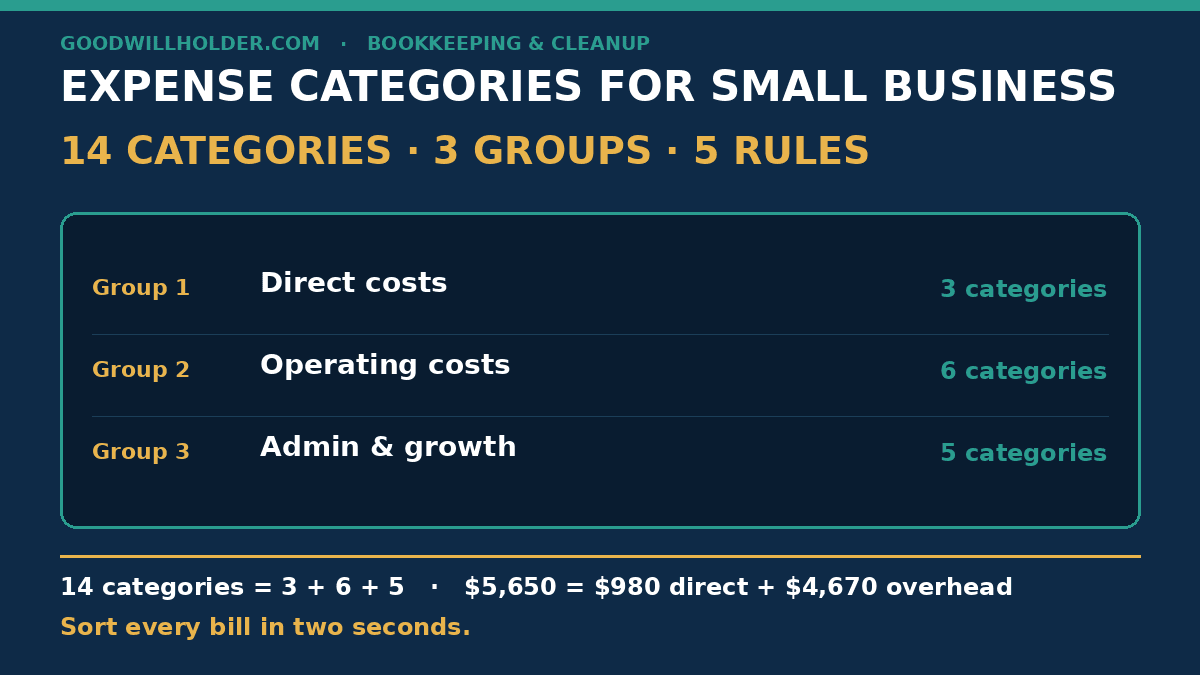
Three groups, fourteen categories
The simplest expense categories for small business setup sorts costs into three families: what makes the thing, what keeps the lights on, and what wins the next customer.
Group 1: Direct costs — 3 categories
- Cost of goods sold — ingredients, materials, and supplies consumed delivering the sale.
- Direct labor and subcontractors — people who make or deliver the thing itself.
- Delivery and shipping — freight, courier, and postage on customer jobs.
Group 2: Operating costs — 6 categories
- Rent and utilities — premises, electricity, water, internet, phone.
- Salaries and wages — regular pay, hourly pay, bonuses, commissions.
- Employee benefits — health cover, retirement contributions, workers’ comp.
- Software and subscriptions — accounting tools like Xero, cloud storage, industry apps.
- Office supplies and equipment — stationery, computers, small furniture.
- Insurance — liability, property, professional indemnity, vehicle.
Group 3: Admin and growth — 5 categories
- Marketing and advertising — ads, website hosting, print, PR.
- Professional services — CPA, bookkeeping, legal, consulting fees.
- Bank and processing fees — account charges, card fees, gateway fees, loan interest.
- Travel and vehicle — fuel, mileage, flights, lodging, parking.
- Licenses, dues, and training — permits, trade bodies, courses, publications.
3 + 6 + 5 = 14 categories. That is the whole list. Anything you cannot place is a naming problem, not a new category.
Five rules for sorting any bill
Here is how to set up expense categories for small business books and then sort anything in seconds:
- Ordinary and necessary. If the expense is personal, or no ordinary business would run without it, it does not enter the books.
- Direct or overhead. It belongs in cost of goods sold only if it makes or delivers the sale. Everything else is operating or admin.
- Fixed, variable, or capital. Fixed costs hold steady (rent), variable costs move with sales (materials), and capital purchases — a $2,000 oven — are not “this month’s expense” at all; they get depreciated over their life.
- One category, forever. Same vendor, same bucket, every time. Write the rule down so future-you never debates it.
- Receipt or it did not happen. Keep proofs for the period your tax authority requires — typically three to seven years. The IRS small business pages set the US rules.
A worked example: Lakeview Bakery’s June
Here is what expense categories for small business look like in practice. Lakeview Bakery’s June bills, sorted:
- Ingredients and materials (direct): $980
- Wages: $3,000
- Rent: $1,200
- Utilities: $180
- Software: $60
- Marketing: $130
- Bank fees: $25
- Insurance: $75
Total: $5,650 = $980 direct + $4,670 overhead. Eight lines, and the month is readable at a glance. The $2,000 oven bought in June is not on this list at all — it is a capital purchase, depreciated over its life, parked at account 1500 in the chart of accounts for small business. And when a bill refuses to fit any bucket, resist the urge: that is usually an uncategorized expense in the making, fixed by rule 4.
Common questions
How do you categorize expenses for a small business?
Start from the fourteen expense categories for small business above, then apply the five rules: ordinary and necessary, direct vs overhead, fixed vs capital, one permanent home per category, and a kept receipt. Consistency matters more than perfection — your tax return reads a steady map, not a clever one.
What are 10 examples of expenses in business?
Rent, utilities, wages, inventory or ingredients, insurance, software subscriptions, marketing, bank fees, professional fees, and travel are the ten most common. Every one of them fits a category from the list above — which is the point of keeping the list short.
What are the 7 basic accounting categories?
Most teaching lists name seven: assets, liabilities, equity, revenue, gains, expenses, and losses. Day to day, five matter for a small business — assets, liabilities, equity, revenue, and expenses — and the categories on this page live inside the last one.
What are the 7 types of cost classification?
The seven labels accountants use most are fixed, variable, direct, indirect, operating, capital, and sunk. For sorting bills they show up in rule 3: fixed and variable shape the budget, capital costs get depreciated, and direct costs belong in cost of goods sold.
If you would rather not do it
You do not have to build the map alone. I set up expense categories and money-tracking spreadsheet systems for small service businesses in the US and UK, and I clean up files where the buckets have stopped working. Start with a bookkeeping cleanup, or write through the contact page on this site.
Key takeaways
- Expense categories for small business work best as 14 buckets in 3 groups: direct, operating, and admin or growth.
- Cost of goods sold is only for what makes or delivers the sale — everything else is overhead.
- Capital purchases are not monthly expenses; depreciate them instead.
- Same vendor, same category, every time — consistency is the whole skill.
- Keep receipts, review the list monthly on the month end close checklist, and the P&L stays honest.