
What Scope Creep Looks Like
Scope creep is the slow expansion of a project beyond what was agreed — one extra tweak, one unbillable call, one “small favor” at a time. It is the most common profit leak in service work, and the fix is not confrontation but structure: written scope, change orders, and five polite sentences that say no without losing the client.
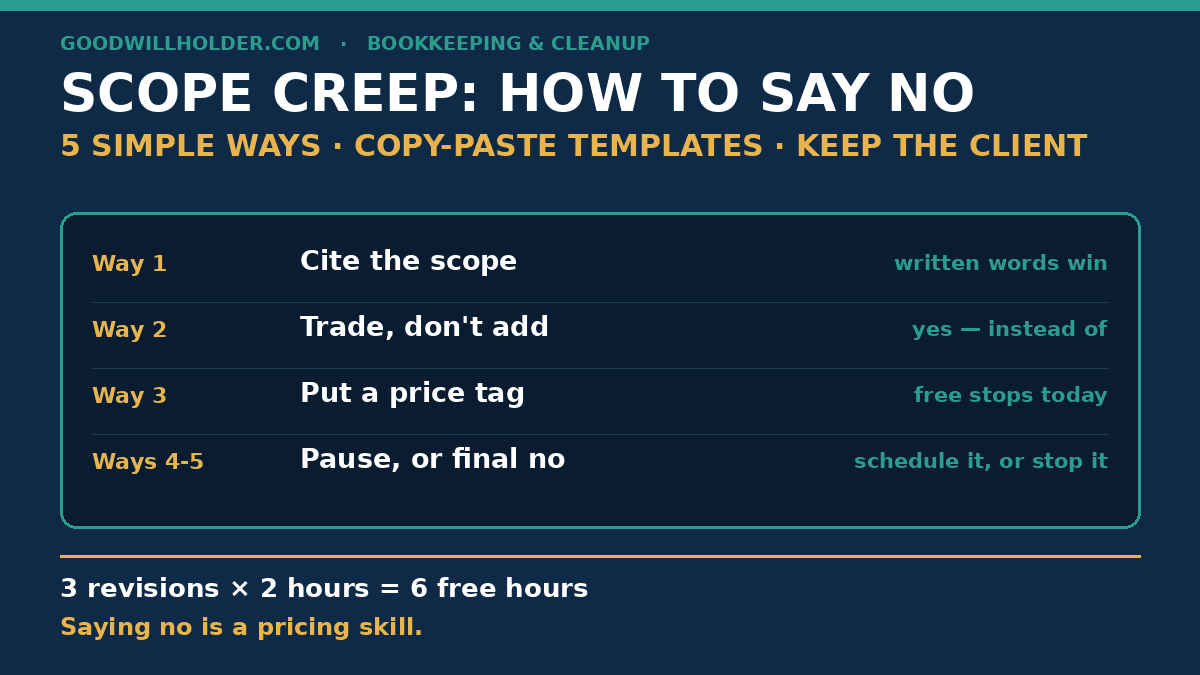
It rarely arrives as a big demand. It looks like this: a “final” revision that is revision number four. A weekly call nobody scoped. “Just add a logo variation.” A deadline that moves twice — both times toward your weekend. Three revisions at two hours each is six free hours; on a $1,200 project that is a silent 25% discount you never agreed to.
Why It Happens
Scope creep is rarely malicious. Clients push because nobody drew the line: your proposal said “logo design,” and their mental model of logo design includes variations, source files, and “one quick resize for Instagram.” Every request you quietly absorb becomes the new baseline — silence reads as agreement. The good news: because it is a boundary problem, not a character problem, words fix it.
5 Simple Ways to Say No
Five responses to scope creep, each one a yes to the work and a no to it being free. Copy, bracket, send.
Way 1 — Cite the scope. The written document does the arguing.
Happy to add [request]! Just flagging that it sits outside the scope we agreed in the proposal. I will send a quick change order with the cost and timeline so you can decide — should take me five minutes. Want me to send it over?
Way 2 — Trade, do not add. Give them a choice, not a bill.
Yes, we can do [request]. To keep the current timeline and budget, it would replace [deliverable B] in this phase — or we can add both and move delivery out by [X days] with a change order. Which do you prefer?
Way 3 — Put a price tag on it. Cheerfully, immediately, specifically.
Sure! [Request] takes about [X hours] at my rate — that adds [$Z] to the project and [N days] to delivery. Shall I send the change order for approval?
Way 4 — Park it. For ideas that are good but not now.
That is a good idea — let’s not lose it. I have logged it for phase two so it does not slow down [current deliverable]. We can price it properly when we plan that phase.
Way 5 — The clear final no. For repeated free asks after you have priced twice.
I can’t include [request] within the current budget — it is real work and I do not do it unpaid. If the budget is fixed, the scope stays as agreed. If the need is real, the change order is the way. Happy either way.
The Two Documents That Prevent It
Scripts handle the moment; two documents stop scope creep before it starts:
- The scope clause. Three sentences in every proposal: the project includes only the deliverables listed; anything not listed is out of scope; out-of-scope work starts only after a written change order is approved. Verbal requests do not change scope. (Full wording in this scope creep clause guide.)
- The change order. One page: what is being added or removed, the price, the new timeline, and an approval line. No work begins until it is signed. Send it as a separate line item on the invoice so the client sees exactly what it cost — your invoice log keeps the history straight.
Both belong to the first week, not the first fight: expectations set during client onboarding are absorbed; expectations set during a dispute are contested.
Quick Checklist
Run this scope creep check on every live project today:
- ☐ Proposal lists deliverables AND explicit exclusions.
- ☐ Scope clause with change-order rule is in the agreement.
- ☐ Revision cap written (“two rounds included”).
- ☐ One feedback channel — not five.
- ☐ Every extra request answered within 24 hours with one of the five scripts.
- ☐ Change orders signed before the work starts, invoiced as separate lines.
Scope creep is not a client problem — it is a pricing skill waiting to be learned. Say yes to the work, no to it being free, and put every extra in writing. Clients do not respect freelancers who fold; they respect the ones whose “yes” means something because their “no” does too.
Two references worth keeping: the scope clause template and OnBrio’s prevention process.