
Late Payment Follow Up Sequence: 5 Simple Emails That Work
Why a Late Payment Follow Up Sequence Beats Improvising
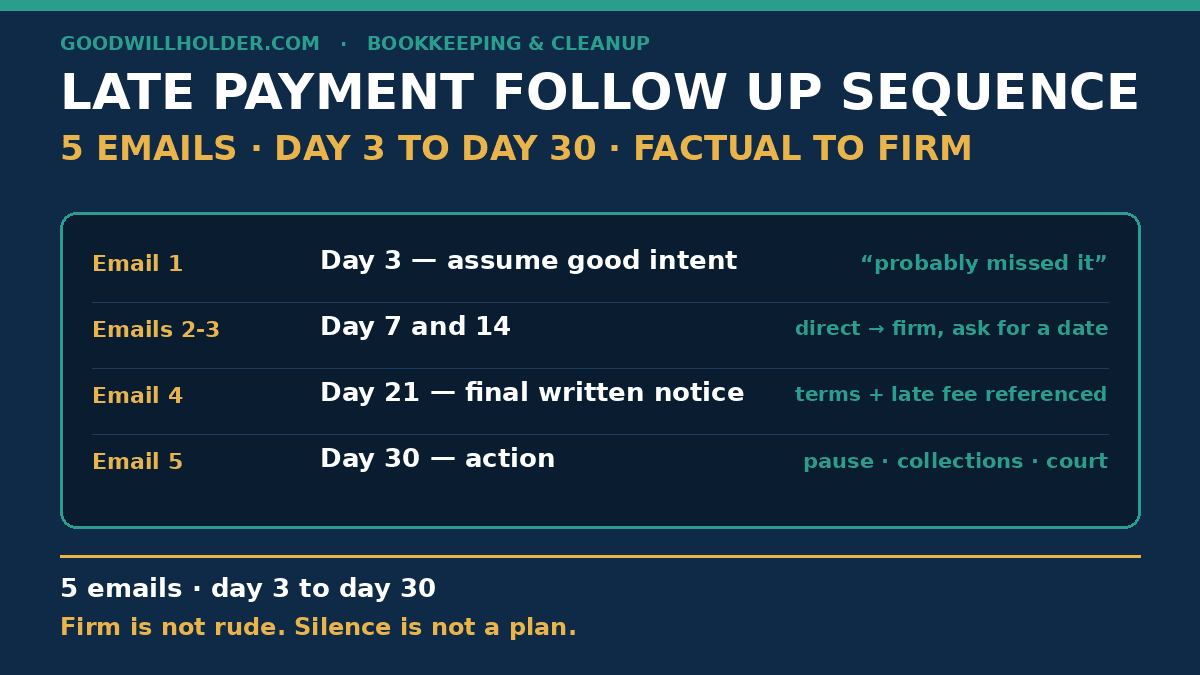
A late payment follow up sequence is a set of scheduled emails sent after an invoice passes its due date — five, spaced from day three to day thirty. Each message gets firmer while staying factual: the invoice number, the amount, the days late, and one clear demand. Follow it exactly and most invoices pay before the final email.
Improvising loses both ways. Chase too softly and the invoice ages quietly; chase too hard in week one and a good client gets embarrassed. A written late payment follow up sequence removes the decision from the moment you are angry — the tone was set on a calm day, by you, in advance.
This page gives you the five emails and the schedule that makes them work. Download the free tracker below to run it per invoice: enter the due date and it calculates every send date, tells you which email is due today, and flags anything that has crossed 30 days.
Download the late payment follow-up tracker
One row per unpaid invoice. Enter the due date and the workbook calculates days late, the current stage, and the date each of the five emails is due — plus the day-5 phone call. The Email Templates tab carries all five messages, ready to copy. Works in Excel or Google Sheets. No macros.
The 5 Emails
These five emails are the late payment follow up sequence itself. Copy, fix the brackets, and send strictly on schedule — the dates matter more than the words.
Email 1 — Day 3 late: assume good intent
Subject: Invoice [1042] — past due [Aug 12]
Hi [Name],
I noticed invoice [1042] for [$2,400] passed its due date on [Aug 12] — I assume it slipped through. Here is the link to clear it: [payment link].
If the invoice never reached the right person, tell me and I will resend it today.
Email 2 — Day 7: direct, ask for a date
Subject: Invoice [1042] — 7 days past due
Hi [Name],
Following up on invoice [1042] for [$2,400], now 7 days past due. Can you reply with the date payment will go out?
If something on the invoice needs changing, say what you need and I will handle it.
Email 3 — Day 14: firm, terms on the table
Subject: Invoice [1042] — 14 days past due, action needed
Hi [Name],
Invoice [1042] for [$2,400] is now two weeks past due. Per the payment terms we agreed, late fees begin to apply. I would like to avoid that — please pay here: [payment link], or reply with a firm payment date this week.
Email 4 — Day 21: final written notice
Subject: Final notice before action — Invoice [1042]
Dear [Name],
This is the final written notice on invoice [1042] for [$2,400], now 21 days past due. Unless payment or a written payment plan is agreed by [date], I will [pause ongoing work / apply the late fee / hand the account to collections].
I would much rather close this simply.
Email 5 — Day 30: the action itself
Subject: Account escalated — Invoice [1042]
Dear [Name],
Invoice [1042] for [$2,400] remains unpaid at 30 days past due, despite four written notices. As of today the account is [paused / referred to collections / prepared for small claims].
You can still stop this by paying in full: [payment link]. Any payment plan must be agreed in writing before [date].
What Happens Between the Emails
The sequence is half the system. Between the emails:
- Day 5–6: one phone call. Two minutes, warm tone: “Hey, checking the invoice landed — anything blocking it?” Calls convert the polite non-payers faster than any email.
- Log everything. Promised dates, partial payments, disputes. A tracker keeps your invoice log and pending payments sheet honest.
- Pause new work once Email 4 goes out. Continuing to work is a fresh loan every day.
- Answer disputes fast. If the invoice is questioned, the late payment follow up sequence pauses for the answer — then restarts where it stopped.
When to Break the Sequence
Three situations deserve an exception, handled outside the schedule:
- A promised date that arrives. The client gets one — exactly one — rescheduled promise. The broken-promise note goes out the day after it passes, and the ladder resumes at full speed.
- A partial payment. Acknowledge it, restart the clock on the remainder, keep the tone warm.
- A client in genuine trouble. A written plan beats a fight: “half now, half in 30 days” often collects more than collections ever will.
If Email 5 Changes Nothing
Now the options are real ones, and they should have been named in your contract from day one: a collections agency (they keep a percentage), small claims court (cheap, slow, effective with written agreements), or writing the debt off with a lesson attached. Whatever you choose, say it once in writing and then act. Threats you do not execute teach clients that your invoices are optional — and that reputation follows you to the next project. When the debt is finally settled or written off, the adjustment still has to land somewhere — that is a line on the month end close checklist, not a footnote.
Quick Checklist
Before the late payment follow up sequence goes live for a client, confirm:
- ☐ The invoice actually has due dates and late terms written on it.
- ☐ Emails are pre-written, bracketed fields only.
- ☐ Calendar reminders exist for days 3, 7, 14, 21, 30.
- ☐ The day-5 phone call is on the calendar too.
- ☐ Escalation words in Email 4–5 are actions you will really take.
A late payment follow up sequence turns anxiety into procedure. You are not being mean — you are running the plan the invoice already promised. Firm is not rude; silence is not a plan. Run the five emails, make the one call, and let the schedule carry the awkwardness so your bank account does not carry the cost.
Frequently Asked Questions
How do I run a late payment follow up sequence per invoice?
Use one row per unpaid invoice in the tracker. Enter the due date and the workbook calculates days late, the current stage, and the send date for each of the five emails. Record what you sent on the “Sent Through” column so the next action is always visible.
What if the client promises a date and misses it?
One rescheduled promise is reasonable. Send a short note the day after it passes, then resume the sequence at the day 21 step rather than restarting from the beginning.
Should I pause work when an invoice goes unpaid?
Many businesses pause new work once the final written notice goes out. Whatever you decide, state it in your terms up front and apply it consistently — a rule you only enforce sometimes is hard to defend.
Does the tracker send the emails for me?
No. It schedules and records them. You copy the message from the Email Templates tab and send it from your own email account. The workbook contains no macros and does not connect to your mailbox.
This guide offers a follow-up routine and template wording, not legal or financial advice. Collection, interest and small-claims rules differ by location and by contract — confirm what applies to your business with a qualified adviser before relying on the escalation emails. Only use escalation wording for actions you will actually take.
Tone and cadence references: GoCardless on writing late payment emails and this payment reminder timing guide.