
A depreciation schedule template is a table that spreads the cost of an asset across the years you use it, instead of dumping the whole purchase into one month. It needs five columns and one formula. This guide shows the columns, the formula, and a worked example you can copy.
You can download the free depreciation schedule template now, or read the five steps first and build it yourself in twenty minutes. The file has three tabs: the register, an India tax tab, and a US MACRS tab.
What a Depreciation Schedule Template Contains
Every working depreciation schedule template has the same parts, whatever the file looks like. If one is missing, the schedule stops matching your accounts within a year.
- One row per asset, never one row per year. The year columns spread to the right, not down.
- Cost and date in use. The date the asset started being used in the business decides the first year charge, not the invoice date.
- Useful life and method. Straight line or written down value, and how many years each asset runs.
- Opening and closing book value. The schedule must roll forward: this year's closing becomes next year's opening.
- Accumulated depreciation. The total charged so far, which is also what your balance sheet shows as a credit against the asset.
The five parts and what breaks without each one
| Part | What it holds | What breaks without it |
|---|---|---|
| Asset row | Name, tag, location, purchase invoice | Two people depreciate the same laptop twice |
| Cost and date in use | What you paid, when it started earning | First-year charge is wrong by half |
| Life and method | Years, straight line or WDV | Book and tax numbers drift apart silently |
| Yearly charge | One column per year | Total depreciation never ties to the ledger |
| Closing book value | Cost less accumulated | Balance sheet shows assets you no longer own |
The 5 Steps to Build the Depreciation Schedule Template
- List every fixed asset you still own and use. Open the fixed asset ledger, not the bank statement. Anything under your capitalisation threshold goes to expenses, not here.
- Set your capitalisation threshold in writing. Most small businesses pick somewhere between 5,000 and 50,000 in local currency. Below it, expense the item; above it, depreciate it.
- Add cost, date in use, life and method to each row. Date in use is the day the asset was ready to work, which for a laptop is the day it was set up, not the day it was ordered.
- Write one formula for the yearly charge and copy it right. Straight line is cost divided by life, and it is the same number every year. Written down value is the opening book value times the rate, and it shrinks every year.
- Roll the schedule forward every month end. Closing book value becomes next month's opening. If the schedule is a standing tab, this is a formula; if it is rebuilt each year, it is the step people skip.
Step four is where most depreciation schedule templates go wrong. Straight line and written down value produce different totals, and a sheet that mixes them in one column looks correct for a year and then stops reconciling.
A Worked Example With Real Numbers
A small design studio buys three things in one year. Watch how the same template handles a cheap laptop, an expensive one, and a piece of furniture bought late in the year.
Three assets, straight line, in a single schedule
| Asset | Cost | Date in use | Life | Year 1 charge | Year 2 charge |
|---|---|---|---|---|---|
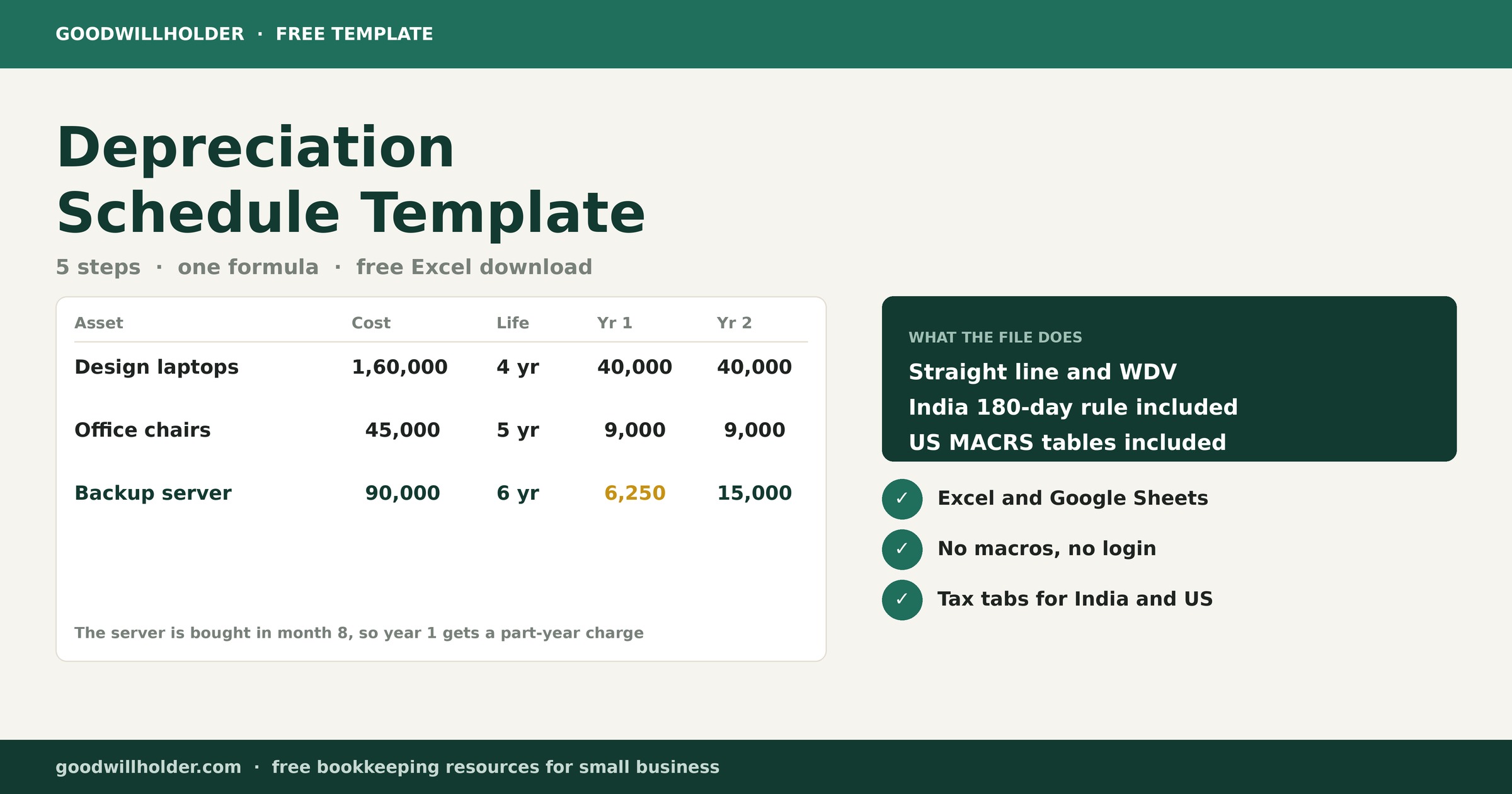
| Design laptop, 2 units | 160,000 | 1 Apr | 4 years | 40,000 | 40,000 |
| Office chairs and desk | 45,000 | 1 Apr | 5 years | 9,000 | 9,000 |
| Backup server | 90,000 | 1 Nov | 6 years | 6,250 | 15,000 |
The server is the interesting row in this depreciation schedule template. Cost divided by six years is 15,000 a year. Bought on 1 November with a 31 March year end, it was in use for five months, so only five-twelfths of the annual charge lands in year one.
Inside the depreciation schedule template that is 15,000 multiplied by 5 and divided by 12, which is 6,250 if you spread it by month from the date in use. Many small businesses use a simpler half-year rule and charge half the annual amount. Pick one convention, write it at the top of the schedule, and keep using it.
The other two rows are clean because they started on day one of the year. That is why timing a purchase matters: an asset bought in the first month gets a full year of charge, and the same asset bought in the eleventh month gets two months of it.
Get the file. Download the depreciation schedule template as an Excel workbook. Three tabs, no macros, opens in Excel, LibreOffice or Google Sheets. It works out months-in-year-one from the date in use, so a part-year charge is automatic.
Straight Line or Written Down Value in the Template
A depreciation schedule template needs one method chosen per row, and there are two in common use. They answer different questions. Straight line spreads the cost evenly for your own accounts. Written down value applies a fixed percentage to the remaining value, so the charge is heavy at the start and light at the end.
- Straight line: cost divided by useful life, the same charge every year. Easier to explain, easier to check, and what most small businesses use for their own books.
- Written down value: opening book value multiplied by the rate. The charge falls every year and never reaches zero on its own.
- Which to use: straight line for your management accounts, and whatever your tax authority prescribes for the tax computation. They do not have to match.
The mistake is assuming they do match. Your accounts can depreciate a laptop over four years while the tax rules allow it faster or slower. The difference is a timing difference, tracked on a separate tab, not an error to be corrected.
India: Block of Assets and the 180-Day Rule
Most depreciation schedule templates are built asset by asset. India does not do that for income tax. The Income-tax Act groups assets into blocks that share a rate, applies the written down value method to the block as a whole, and stops caring about individual assets.
Depreciation rates commonly met under the Income-tax Act
| Block of assets | Rate on written down value |
|---|---|
| Buildings, general | 10% |
| Furniture and fittings | 10% |
| Plant and machinery, general | 15% |
| Computers, laptops and computer software | 40% |
| Motor cars, other than for hire | 15% |
Two rules do most of the damage to a first draft. The 180-day rule: an asset acquired and put to use for fewer than 180 days in the year of acquisition gets only half the normal rate that year, and the full rate from the next year.
And the block movement: you add the cost of everything bought in that block, subtract the sale proceeds of anything sold from the same block, and apply the rate to the result. If sale proceeds exceed the block's opening value plus additions, the difference is a short-term capital gain, not a negative depreciation.
Rates and thresholds change with the Finance Act. The Income Tax Department portal publishes the current schedule, and your CA will apply the rate for your assessment year, not a rate remembered from an older return.
US: MACRS and the Half-Year Convention
A US depreciation schedule template needs the MACRS columns as well as the book ones. MACRS assigns each asset a statutory recovery period by class and ignores salvage value. Computers, office equipment and vehicles are five-year property. Office furniture and most machinery are seven-year.
MACRS half-year convention percentages, Table A-1
| Year | 5-year property | 7-year property |
|---|---|---|
| 1 | 20.00% | 14.29% |
| 2 | 32.00% | 24.49% |
| 3 | 19.20% | 17.49% |
| 4 | 11.52% | 12.49% |
| 5 | 11.52% | 8.93% |
| 6 | 5.76% | 8.92% |
Five-year property takes six years to write off because of the half-year convention: the first year gets half a year and the last year picks up the other half. Year two is larger than year one for the same reason.
The mid-quarter convention replaces this when more than 40 per cent of the year's total depreciable basis is placed in service in the last three months. That is a step most small businesses miss in December, and it changes every asset in the year, not just the December ones.
Section 179 expensing and bonus depreciation sit on top of MACRS and can remove an asset from the schedule entirely in year one. The percentages above are in IRS Publication 946, which is the source to check rather than a table copied from a blog.
Mistakes That Break a Depreciation Schedule Template
- Depreciating from the invoice date. The clock starts when the asset is put to use, which is often weeks later.
- Adding a new asset to the wrong block or class. One laptop in the furniture block quietly halves its annual charge.
- Forgetting disposals. Sell the old server and the schedule keeps charging for it, and the balance sheet shows an asset that is gone.
- Mixing book and tax on one tab. Use two tabs, or two clearly marked columns. One tab always loses.
- No asset tag. Without a tag, the schedule and the physical cupboard drift apart within two years.
A short annual task prevents all five in any depreciation schedule template: walk the office with the schedule printed, tick every asset you can physically see, and write off the rest. Ten minutes a year beats a week of cleanup at audit.
How This Connects to the Rest of Your Books
Every figure in the depreciation schedule template ends up as a journal entry, and it has to be posted like any other. Debit depreciation expense, credit accumulated depreciation. If that entry does not balance, the journal entry balancer will show you where the two sides disagree.
From there it lands in the trial balance, and the accumulated depreciation figure has to match the closing book value column on your schedule. If both numbers are not the same, one of them is wrong. Our trial balance guide walks through the check.
If your fixed asset records behind the depreciation schedule template are already out of date, fix them before you try to depreciate anything, using the bookkeeping cleanup guide. A schedule built on wrong opening balances stays wrong for its whole life. Once the figures are clean, the posting itself belongs on a close routine — the close checklist template keeps depreciation as one of its seventeen rows, alongside the reconciliations it depends on.
Frequently Asked Questions
What is the simplest depreciation method for a small business?
Straight line: cost divided by useful life, charged evenly. It is the easiest to explain, and the easiest to check years later when nobody remembers the purchase. The free template starts on straight line and switches to written down value per row.
Do I need a separate tab for book and tax depreciation?
Yes, unless the two methods happen to be identical. Keep one tab for your accounts and one for the tax computation, then reconcile the difference at year end. One tab always ends up wrong.
What is the 180-day rule in India?
If an asset is acquired and put to use for fewer than 180 days in that financial year, only half the normal depreciation rate applies in the first year. The full rate resumes from the following year on the written down value.
Can I depreciate something I bought but have not started using?
Not normally. Depreciation starts when the asset is put to use for the business. An item sitting in its box is an asset on the balance sheet with no charge yet, and that is the correct treatment.
Does depreciation put cash in the bank?
No. It allocates a cost you have already paid. It reduces taxable profit, which can reduce a tax bill, but it is not a cash movement and should never be treated as one in a cash flow forecast.
Sources and Editorial Note
US figures are from IRS Publication 946, Table A-1, read on 22 November 2026. Indian rates and the 180-day rule were checked against the depreciation schedule published on the Income Tax Department portal on the same date. Rates, thresholds and conventions change; confirm with your accountant for your own assessment year.
The depreciation schedule template file and the worked example use illustrative numbers for a two-person design studio and is not a real client file. Nothing here is accounting, tax or legal advice.